



Every week someone pulls into the shop in Inman and asks the same thing: how dark can I legally go? The answer in South Carolina has not changed in over thirty years, but almost everything else people believe about it is wrong — including the part that can cost a tint shop a thousand dollars per window.
Here is what the law actually says, straight from South Carolina Code § 56-5-5015, and what it means for your car.
Short answer: 27% VLT is the legal minimum on every side window and on the rear window. Darker than that is illegal on a passenger car. The windshield gets film only above the AS-1 line. Red, yellow and amber film is banned outright, and every tinted window must carry a compliance sticker.
The legal numbers, window by window
VLT means Visible Light Transmission — the percentage of light the glass lets through. A lower number is a darker film. And the law measures the combined result of your film plus whatever tint the factory already put in the glass, which is why a 35% film on factory-tinted glass can measure below 35% on a meter.
| Window | Legal minimum | What that means |
|---|---|---|
| Front side windows | 27% VLT | 35% is safely legal. 20% is not. |
| Side windows behind the driver | 27% VLT | Same rule as the front on a passenger car. |
| Rear window | 27% VLT | Both outside mirrors required if it is tinted. |
| Windshield | Strip only | Above the AS-1 line, nothing below it. |
That is the whole table. There is no separate, more generous limit for rear windows in South Carolina the way there is in many states — the 20% figure you may have read applied before 1 January 1993 and has not been the law since.
The windshield rule people get wrong
You may run a non-reflective strip along the top of the windshield, but it may not extend below the AS-1 line — the small marking etched near the top of most windshields. And there is a catch written into the statute: if the AS-1 line is not visible, no film may be applied to the windshield at all.
This is why a full clear windshield film is a different conversation from a tint strip. A near-invisible film like X Clear at 70% VLT is about rejecting heat rather than darkening glass, and it is the option most customers end up on when they want the windshield to stop cooking them without breaking the rule above.
Colour and reflectivity
The statute is blunt: a sunscreening device must be non-reflective and may not be red, yellow or amber. That rules out the mirrored and metallic looks and the coloured films that show up in online marketplaces. “Non-reflective” is defined in the law as a material designed primarily to absorb light rather than reflect it — which is exactly what carbon and ceramic films do and what cheap metallised film does not.
The compliance sticker almost nobody knows about
This is the part that surprises people. Under subsection (E), every vehicle with after-factory film must at all times carry a certificate of compliance, attached inside the lower right-hand corner of each tinted window, showing:
- the percentage of light transmission the film allows;
- the installer’s name, address and telephone number;
- the date of installation.
And the penalties are not symmetrical. A professional tinter who installs film without permanently affixing that certificate is guilty of a misdemeanour and faces a fine of not less than $1,000, or up to thirty days, for each offence. A consumer doing their own film faces not less than $200 on the same provision.
What this means when you shop: if a shop quotes you a price and does not mention stickers, they are either going to skip them or they do not know the rule. Ask. It costs you nothing and it tells you a lot about who is touching your car.
The exception that changes everything for SUVs and vans
Subsection (I) is the most useful sentence in the statute and the most overlooked. The light transmittance requirement applies to windows behind the driver on pickup trucks — but it does not apply to windows behind the driver on other trucks, buses, trailers, mobile homes, multipurpose passenger vehicles and recreational vehicles.
A “multipurpose passenger vehicle” is defined in the law as a vehicle carrying ten people or fewer, built either on a truck chassis or with special features for occasional off-road use. A great many SUVs and vans fall into that definition.
In practice: on a qualifying SUV, the two front windows still have to meet 27%, but the glass behind the driver can go considerably darker without breaking this section. On a sedan, every window is held to 27%. On a pickup, the rule follows you to the back.
This single distinction is why two customers can leave the same shop on the same day with very different-looking vehicles and both be legal.
Medical exemption
South Carolina does allow darker film for a documented medical need. The requirements are specific:
- an affidavit signed by a physician or optometrist licensed in South Carolina, stating the condition makes the darker film necessary;
- the affidavit must be in the vehicle at all times and produced on request by law enforcement;
- it must be renewed every two years.
The exemption attaches to a vehicle registered to that person or their legal guardian. It is not a blanket permission and it does not transfer with the car when you sell it.
What it costs if you get it wrong
Driving a vehicle tinted in violation of the section is a misdemeanour triable in magistrate’s court: a fine of not more than $200 or up to thirty days. The practical cost is usually worse than the ticket — you are told to remove the film, and removal plus re-tinting costs more than doing it right the first time.
Did the law change in 2026?
No — though it nearly did. House Bill 3151 in the 2025–2026 session proposed dropping the side-window requirement from 27% to 20%, which would have made a noticeably darker film legal. The bill died in May 2026. The 27% standard stands.
It is worth knowing that this gets proposed repeatedly — similar bills appeared in earlier sessions and went nowhere. If it ever does pass we will update this page, because we would rather send you out legal than send you out dark.
So what should you actually put on the car?
For a sedan where every window is held to 27%, the honest recommendation is 35% VLT. It clears the limit with margin for the meter and for factory glass, and it still looks like a proper tint job.
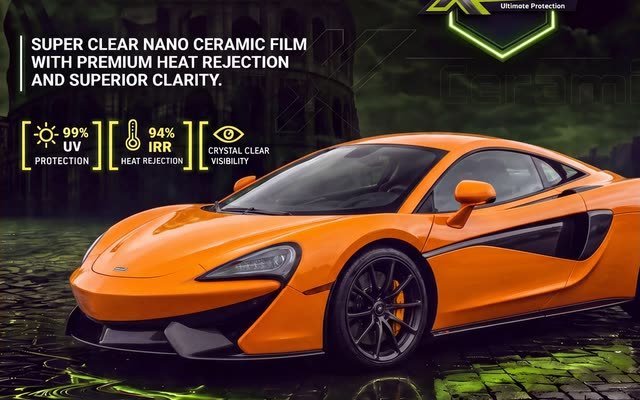
If what you are really chasing is a cooler car rather than a darker one, the shade is the wrong lever. Heat is infrared, and infrared rejection is a property of the film, not of how dark it is. Our X Pro Ceramic rejects 94% of infrared even at a legal 70% VLT — nearly invisible, and cooler than a cheap limo-dark film that blocks almost no heat at all.
You can see every shade on a car on each film page before you decide: Crystal, X Ceramic, X Pro Ceramic and X Clear.
This article explains the law as written in § 56-5-5015 and is not legal advice. Enforcement is by officer and meter on the day. If you are near the limit, go lighter.
Not sure what is legal on your vehicle?
Tell us the year, make and model — whether it counts as a multipurpose passenger vehicle changes what we can legally do on the back glass. Same-day answers.