


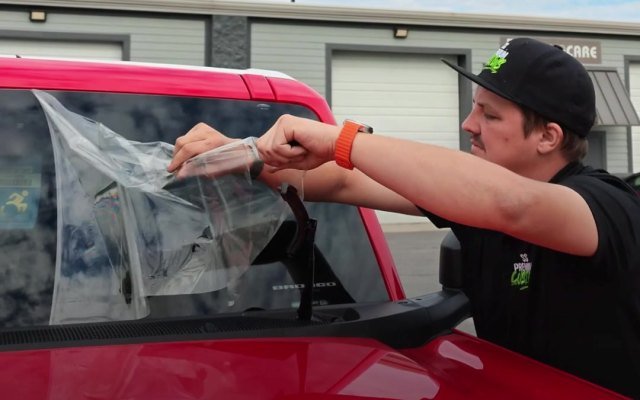



Two cars leave the shop the same afternoon with film that looks identical from across the parking lot. One of them will be noticeably cooler to sit in at 3pm in July. The difference is not the shade — it is what the film is made of.
Here is what actually separates carbon from ceramic, in plain numbers, and how to tell which one you need.
Darkness and heat are two different things
This is the single most expensive misunderstanding in window film, and it costs people money in both directions — some overpay for darkness they do not want, others buy a limo-dark film and wonder why the car is still an oven.
Sunlight reaching your car is roughly 44% visible light, 53% infrared and 3% ultraviolet. The part you see is the visible light. The part you feel as heat is mostly infrared. A film can block one without blocking the other.
A cheap dyed film at 5% VLT blocks almost all the visible light — the car looks blacked out — while stopping very little infrared. A quality ceramic at 70% VLT is nearly clear and stops most of the infrared. One looks serious; the other is serious.
Rule of thumb: VLT is how the car looks. IR rejection is how the car feels. If you are chasing comfort, read the IR number and ignore the shade.
What carbon film is
Carbon film suspends carbon particles in the adhesive layers. The carbon does three useful things: it is colour-stable, it is not metallic, and it gives that flat, matte, factory-looking black that most people picture when they say “tint”.
Colour stability matters more than it sounds. Dyed film — the cheap stuff — fades. The dye breaks down under UV and the film turns that unmistakable purple, usually somewhere between year two and year four. Carbon does not do that; there is no dye to break down.
What carbon does not do is reject much infrared. Our Crystal blocks 99% of UV and holds its colour for the life of the car, but its infrared rejection sits around 20% across every shade. That number does not improve as the film gets darker — going from 50% to 5% changes how the car looks, not how much heat gets in.
What ceramic film is
Ceramic film uses non-conductive ceramic nanoparticles that are selective: they are far more opaque to infrared than to visible light. That selectivity is the entire point, and it is why ceramic can be light and still cool.
Our X Ceramic rejects up to 88% of infrared. Our flagship X Pro Ceramic uses a multi-layer stack and reaches up to 96%. Both are metal-free, so nothing interferes with phone signal, GPS, keyless entry, tyre-pressure sensors or toll tags — the classic failure of old metallised films.
The numbers side by side
All three films below are the same 35% VLT — the shade we recommend most often in South Carolina, because it clears the state’s 27% limit with margin. Identical darkness, very different performance:
| Film at 35% VLT | Infrared rejected | Total solar energy | UV |
|---|---|---|---|
| Crystal (carbon) | 20% | 35% | 99% |
| X Ceramic | 87% | 57% | 99% |
| X Pro Ceramic | 95% | 63% | 99.9% |
Two columns are worth separating. Infrared rejection is the headline number and the one you feel on your arm and the back of your neck. Total Solar Energy Rejected (TSER) counts the entire spectrum — visible, infrared and UV together — and is the more complete measure of how much energy the glass stops overall. Marketing tends to quote IR because it is the bigger number; TSER is the one that describes the whole job.
Where you will actually notice it
Numbers on a page are easy to shrug at, so here is where the difference shows up in a normal week in the Upstate:
- The car after work. Everything parked outside in Spartanburg in July gets hot. The ceramic car is still hot — but it drops to comfortable in a couple of minutes rather than most of the drive home.
- The driver’s left arm. That specific burning on one side during a long drive is infrared coming through the door glass. This is the clearest single difference.
- The A/C. Less heat coming in means the system reaches temperature sooner and cycles less, which matters on a long commute.
- The dashboard, years later. Both films block 99% of UV, so both protect against cracking and fading. On this one, carbon gives up nothing.
So which should you buy?
Choose carbon if the goal is the look, privacy and UV protection at the sharpest price — a work truck, a lease return, a second car, a vehicle that lives in a garage. You are not being talked down to by buying it; it is good film that does its job honestly.
Choose ceramic if the car sits outside all day, if it is black or dark-coloured, if it has a big glass area, if you drive long stretches in the afternoon, or if you have had tint before and the heat is the thing you want fixed this time.
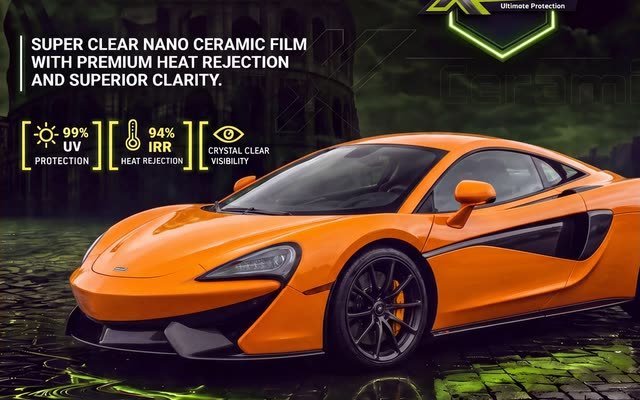
Choose X Pro Ceramic when you want the maximum and you want it to keep working at a light shade — it still rejects 94% of infrared at a near-clear 70% VLT, which is the combination nothing else on this list can do.
One more option people forget: you do not have to use the same film everywhere. A common setup is X Clear at 70% on the windshield — legal, nearly invisible, 94% IR — with a darker ceramic on the sides. The windshield is the largest piece of glass on most vehicles and the biggest single way heat gets in.
Does ceramic cost more? Yes. Is it worth it?
Ceramic costs more because the material costs more — the labour to install it is the same. Whether it is worth it depends entirely on how you use the car. Someone who parks in a garage and drives twenty minutes a day will barely notice. Someone whose truck sits in a lot from seven to five will notice every single day for the next decade.
Both carry a lifetime warranty for as long as you own the vehicle, so durability is not the deciding factor. Comfort is.
The fastest way to settle it is to look at it. Every film page has a preview that puts each shade on a car with the live heat numbers beside it — pick the shade you like, then compare what each film does at that same shade.
Still deciding between the two?
Tell us the vehicle, the colour and where it parks during the day. That is usually enough for a straight recommendation — and we will tell you when carbon is the smarter buy.